12
May 2026
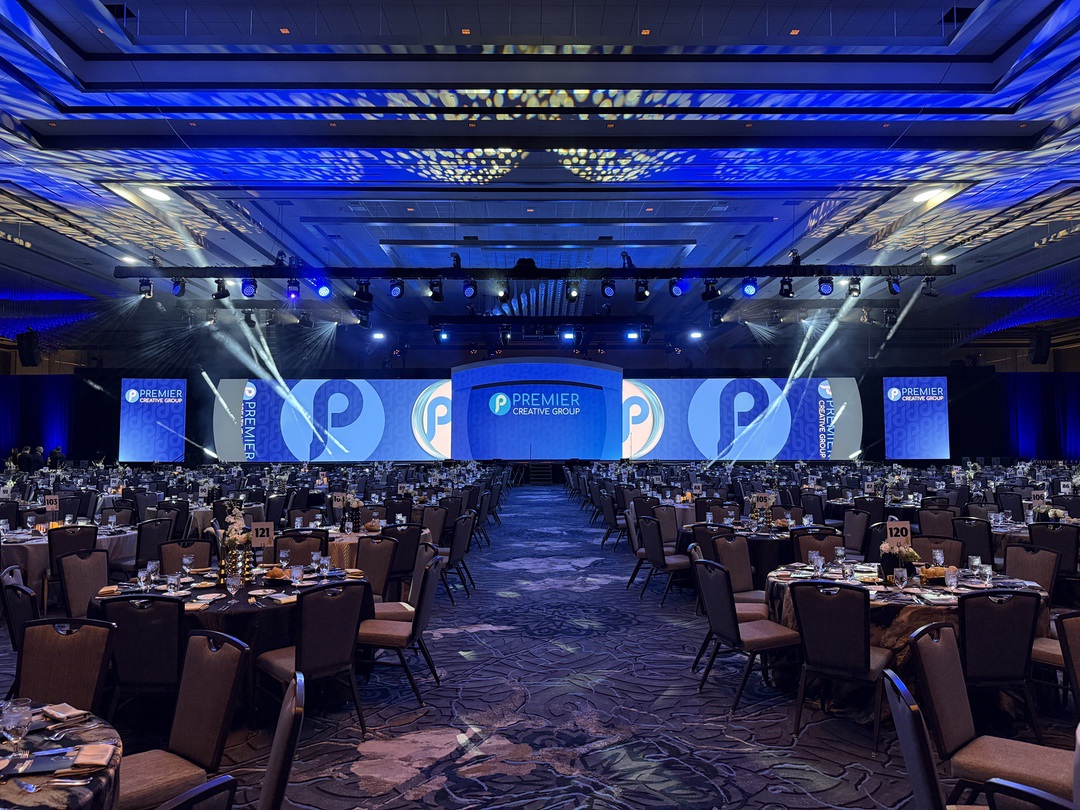
If you’ve ever stood in a convention hall four hours before doors open while the audio team and the scenic crew argued over a speaker stack that doesn’t fit the set, you already understand the problem this article is about to describe. It’s a predictable consequence of how most event production gets bought — and it has very little to do with whether the individual vendors are good at their jobs.
When an event is scoped as a stack of separate services — audio from one company, video from another, lighting from a third, scenic from a fourth, creative from a fifth, and a labor partner managing crew — every one of those vendors is solving a different version of your event in their own head. Then they meet for the first time on the floor. The conflicts that surface during load-in aren’t surprises. They’re math.
A production partner exists to remove that math from your day.
What Is an Event Production Partner?
An event production partner is a single accountable team that owns audio, video, lighting, scenic, creative, and on-site execution as one integrated scope — instead of coordinating six separate vendors who only meet at load-in. It’s a different commercial model than a traditional AV vendor. You’re buying the outcome of the event, not a stack of line items.
At Premier Creative Group, we’ve been building this model for 30+ years. The core idea is simple: every discipline plans the show in the same room, makes decisions together, and shows up to load-in with one unified plan. The result is a quieter load-in, fewer change orders, and a show that runs the way it was designed — not the way the floor forced it to run.
Key Takeaways:
- A production partner owns audio, video, lighting, scenic, and creative as one scope.
- It is a commercial model — not just a feature of working with a larger AV company.
- The integrated model is built to remove load-in surprises, not just deliver gear.
The Hidden Cost of the Multi-Vendor Stack
The split-vendor model looks cheaper on paper because every line item is competitively bid. The cost shows up later — usually within the four hours before the room opens.
Here’s what those costs typically look like:
Change orders. Every conflict caught at load-in becomes a labor or equipment change order. Rush fees, overtime, expedited shipping, repositioned rigging — all paid at floor rates, not planning rates.
Schedule compression. When the scenic build doesn’t fit the lighting design, somebody is staying late or starting earlier. Crew calls extend. Morning rehearsals get cut.
Quality erosion. When something has to give to get the doors open on time, it’s almost always a creative or technical decision the audience will notice.
The math we’ve seen play out hundreds of times: every dollar saved at the bid stage tends to come back as two-to-three dollars in load-in costs the planner didn’t budget for.
Key Takeaways:
- The split-vendor model looks cheaper at bid, not at load-in.
- Change orders, overtime, and rush fees compound fast.
- The handoff tax — vendors deciding what isn’t their scope — eats real production time.
What a Production Partner Actually Owns
A production partner isn’t an AV vendor with a bigger truck. The work is structurally different. Across the engagement, a partner owns:
Discovery. Understanding the event’s objectives, audience, and constraints before any gear gets specified.
Integrated design. Audio, video, lighting, scenic, and creative decisions made in coordination — because screen placement affects audio coverage, scenic affects lighting angles, and these aren’t separable problems.
3D pre-visualization. Showing you the show before anything is built, so changes happen in software, not at load-in. We covered why this matters in our pre-visualization guide.
Pre-production planning. One unified production plan that every discipline signs off on, before crews are dispatched.
On-site execution. A single accountable team on the floor, with one point of contact and one production lead. We work with our own crew so the team you planned with is the team that shows up.
Post-event closeout. Debrief, asset handoff, and the institutional memory that makes the next show easier.
That’s what’s getting bought. Not gear. Not labor. The orchestration of a complete event environment.
Key Takeaways:
- A production partner owns the engagement end-to-end, not just the gear.
- Integrated design is the core mechanic — every discipline planning together.
- The deliverable is a working event, not a list of equipment.
When to Hire Vendors vs Hire a Partner
Not every event needs a production partner. The honest answer about when each model fits:
A vendor stack is usually the better fit for:
Single-room corporate events under 100 attendees.
Single-day brand activations.
Trade show booths with simple AV needs.
Internal meetings with a microphone and a slide deck.
A production partner is usually the better fit for:
Multi-room conferences with general sessions and breakouts.
Multi-city tours that need a consistent experience.
Trade shows with custom scenic builds and interactive content.
Executive keynotes with IMAG, scenic, and RF coordination.
Multi-year, multi-venue contracts.
The rule of thumb: the more disciplines that have to coordinate, the more the partner model pays for itself. A production-grade keynote is rarely the place to save fifteen percent on gear and absorb the chaos that buys.
Key Takeaways:
- Simple, single-room events do fine with a vendor stack.
- Multi-discipline, multi-venue, or executive-visibility events warrant a partner.
- The partner model gets more cost-effective as event complexity rises.
How a National Production Partner Changes the Math
For organizations that produce in more than one city — the multi-event annual conference, the regional roadshow, the multi-venue brand activation — the production partner model has one more advantage worth understanding.
When a partner travels with you, the same team that learned your brand standards in one city shows up in the next with that knowledge intact. You don’t re-onboard a new vendor in each city. You don’t re-explain your stagecraft preferences. You don’t risk three different interpretations of the same brief.
That’s how PCG runs multi-venue contracts. Our home is Metro Detroit; the work isn’t. We’ve delivered productions in 35+ states across hundreds of venues — including a preferred-partner relationship at Huntington Place Detroit since 2014 that’s taught us what flawless venue execution looks like under the most demanding conditions. Same team, same standards, same accountability, every venue. Learn more about our convention services.
Key Takeaways:
A national partner travels with your standards intact.
You don’t re-onboard new vendors city by city.
The partner model makes multi-venue contracts simpler, not harder.
Frequently Asked Questions About Event Production Partners
What’s the difference between an event production partner and an AV vendor?
An AV vendor sells equipment and labor for a defined scope — a particular service like audio, video, or lighting. An event production partner owns the entire production scope as a single integrated team, including planning, design, on-site execution, and post-event closeout. You hire a vendor to fill a line item; you hire a partner to deliver the event.
Is a production partner more expensive than hiring vendors separately?
On a bid sheet, the partner model often looks comparable or slightly higher. The honest comparison is total cost at show close — including change orders, overtime, and load-in problem-solving. In practice, the partner model usually costs less by the time the show is over because integrated planning eliminates the conflicts that drive change orders.
When should we use multiple vendors instead of a single partner?
For simple single-room events with limited AV needs — a small meeting, a basic keynote, a one-day activation — a vendor stack works fine and may be more efficient. The partner model becomes the better choice as soon as multiple disciplines have to coordinate, multiple rooms have to run in parallel, or multiple cities have to deliver the same experience.
Can a production partner handle events in multiple cities?
Yes — and that is where the partner model has the most leverage. A national partner shows up in each city with the same team, the same standards, and the same accountability. You’re not re-onboarding a new vendor in every market. For multi-city tours and multi-venue annual programs, this is usually the only way to deliver a consistent experience.
What does a production partner own that a vendor doesn’t?
Discovery, integrated design across all disciplines, pre-production coordination, 3D pre-visualization, on-site execution, and post-event debrief. The partner model treats the production as one engagement, not a stack of equipment line items.
How do we know if a production partner is the right fit for our event?
Ask how the audio, video, lighting, and scenic decisions get made. If those decisions happen in separate quotes from separate companies and meet for the first time at load-in, you have a vendor stack — and you’ll absorb the cost of that fragmentation. If those decisions happen in one room, in one plan, owned by one accountable team, you’re working with a partner.
Plan Your Next Event With a Real Partner
If your next event is the kind where six vendors meeting for the first time at load-in is a risk you can’t afford, the partner model is what you’re looking for. Premier Creative Group has been delivering integrated event production for 30+ years, with 5,000+ productions across 35+ states.
We’d love to talk through what your show needs. Start planning your event, or call us at (248) 607-0444 to start the conversation. Visit premierav.net to see more of our work.
About Premier Creative Group
Premier Creative Group is a national event production partner delivering audio, video, lighting, scenic, and creative as one integrated team. With 30+ years of live event production and preferred AV partner at Huntington Place Detroit since 2014, we’ve delivered events across 35+ states for corporate, association, and trade show clients. Our home is Metro Detroit; our reach isn’t. Connect with us on LinkedIn.