
Corporate Events / General Sessions
General Session Production Built as One Room, Not Five Vendors
General session production is the design and execution of the main-stage room where your entire audience gathers for the keynote or plenary. It brings audio, LED walls and IMAG, stage lighting and atmospheric design, scenic, and showcalling together as a single system.
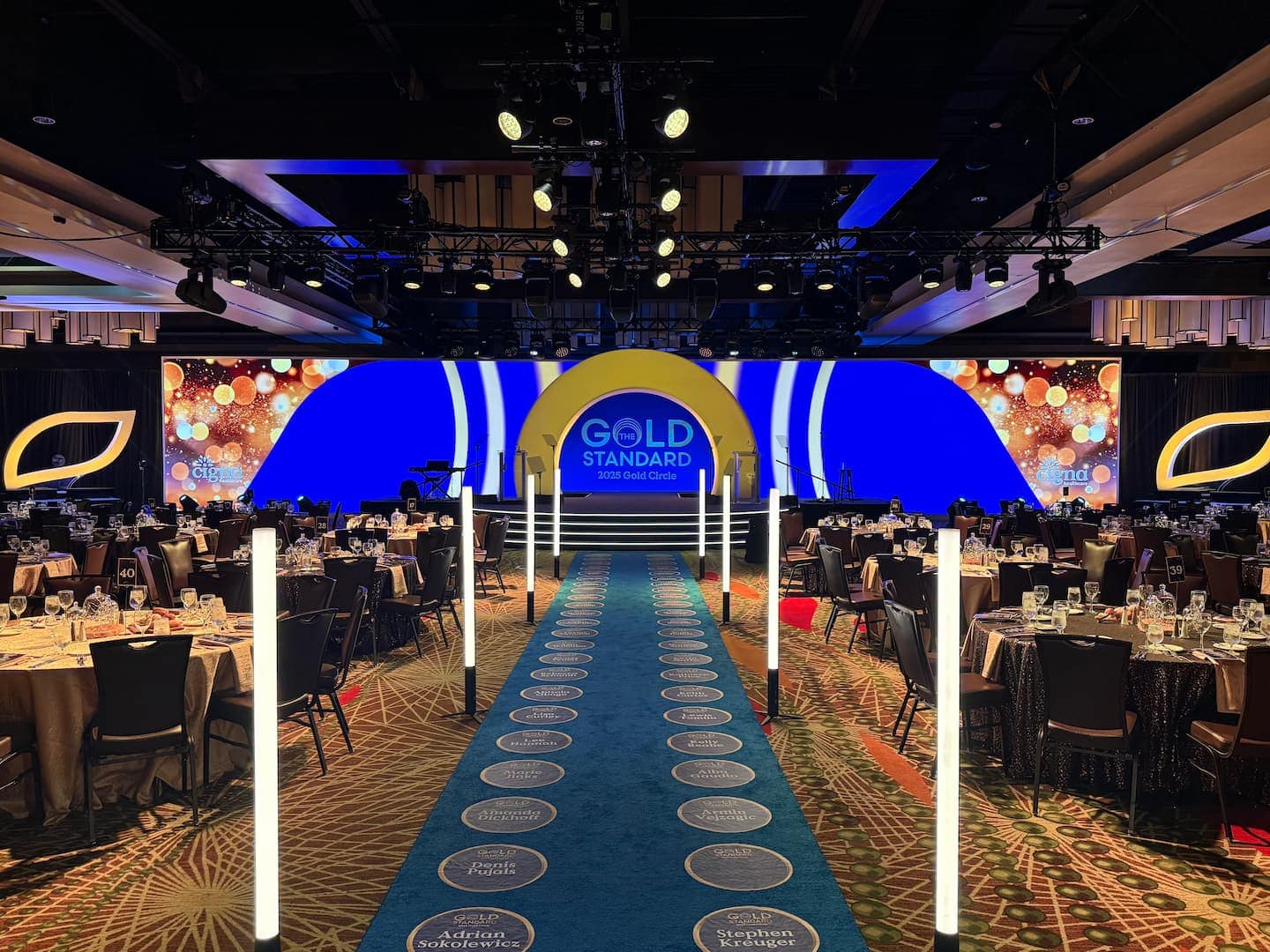
Audio
A main PA tuned for the room, plus RF and wireless mic coordination for presenters, panels, and Q&AVideo
LED walls and IMAG so the person in the back row reads the stage as clearly as the frontLighting
Stage lighting and atmospheric design that shapes the mood without washing out the screensScenic
The set, the frame, the physical stage the audience actually looks atShow Control
A showcaller and stage manager running cues across front-of-house and back-of-houseIt is the highest-stakes room of any event: the moment your leadership, your message, and your brand are in front of everyone at once. We produce it as an integrated whole, from first conversation to final load-out, so nothing lands on the client to coordinate. General sessions sit at the center of most corporate event production plans, and we treat them that way.
The Highest-Stakes Room of Your Event
When the general session goes dark, the whole event feels it. This is the room your CEO walks into, the room where the theme is set, the room every attendee remembers. There is no second take on a keynote, so the production behind it has to hold under pressure the first time and every time after.
A general session is not one thing, it is a stack of disciplines running at once, all of which have to agree with each other on the same clock:
- Audio: a main PA tuned for the room, plus RF and wireless mic coordination for presenters, panels, and Q&A
- Video: LED walls and IMAG so the person in the back row reads the stage as clearly as the front
- Lighting: stage lighting and atmospheric design that shapes the mood without washing out the screens
- Scenic: the set, the frame, the physical stage the audience actually looks at
- Show control: a showcaller and stage manager running cues across front-of-house and back-of-house
Miss the handoff between any two of these and the audience notices, even if they can't name what felt off. Our job is to make the seams disappear.
One Accountable Team, Not Five Separate Vendors
Most general session problems are not talent problems. They are coordination problems: the audio crew, the video crew, the lighting crew, and the scenic shop each doing good work against a slightly different plan. When those groups answer to different companies, the client becomes the integrator by default, chasing conflicts nobody owns.
Our OneSource model removes that. Audio, video, lighting, scenic, and creative are planned together and executed by a single accountable team that carries the room from load-in to load-out. One production lead owns the whole picture, so RF coordination is planned around the LED walls and IMAG, the rigging and motors are hung around the scenic, and the showcaller is reading one unified cue stack.
The crew running your general session is in-house W-2 technicians and stage managers plus a vetted freelance bench when we scale, not subcontractors handed a call sheet the night before. That is a deliberate difference. People who work together every week catch problems in the shop, not on the show floor.
3D Pre-Visualization: See It Before It's Built
The most expensive place to discover a design problem is on-site during load-in. Our signature 3D Pre-Visualization, or Pre-Viz, moves that discovery weeks earlier by letting you see the general session before it is built.
Here is how a general session comes together with Pre-Viz in the workflow:
- Design. We build the room in 3D against an accurate model of your actual venue: scenic and custom builds, screen sizes, sightlines, and stage lighting positions.
- Review. You see camera-eye views of the keynote before a single truss is hung, and we adjust scenic, IMAG framing, and content ratios while changes are still free.
- Lock. The approved look becomes the plan every discipline builds to, so audio, video, lighting, and scenic arrive on the same page.
- Execute. A showcaller runs the locked cues across the general session, with the stage manager coordinating presenters and transitions in real time.
By the time we reach load-in, the surprises are already out of the room.
Proof: We have been the preferred on-site production partner at Huntington Place in Detroit since October 2014, and our flagship general session work includes the Detroit Auto Show, drawing hundreds of thousands of attendees. Beyond our home venue, our core crew has produced main-stage rooms at properties like The Greenbrier, Resorts World Las Vegas, and Gaylord Opryland. Thirty-plus years of live event production sit behind every general session we call.
Consistency When Your General Session Travels Multi-City
A general session that plays in one city is a production. A general session that has to feel identical in four cities is a system. When your roadshow or national conference repeats the keynote across markets, the risk is drift: slightly different screens, a different scenic look, a different crew interpreting the plan their own way.
We hold the line by traveling a core crew that owns the look and the show cues, then supplementing with vetted local labor for load-in and load-out in each market. The design is locked once in Pre-Viz and carried city to city, so the general session your audience sees in Chicago matches the one in Orlando. The same discipline extends across the rest of the event: your breakout session production, your leadership summit production, and your product launch event production inherit the same standards, the same team, and the same accountable point of contact.
That continuity is the whole point of integrated production. Planned together, executed together, one team that already knows your show by the time it hits the second market.