
10
Mar 2026
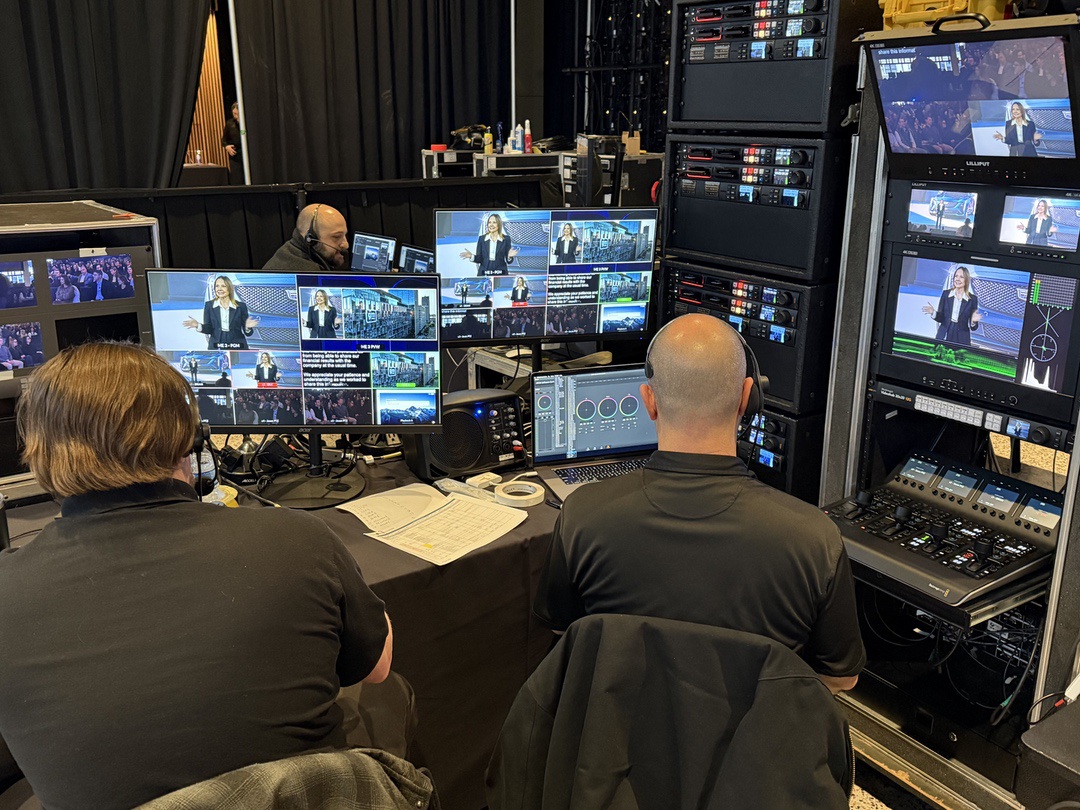
The conference room holds 200 people. The livestream reaches 2,000 more. Yet most of the production budget goes toward the physical space while remote attendees watch a single static camera with audio that sounds like it was recorded inside a tin can.
This approach no longer works. In 2026, hybrid events have matured beyond simply adding a camera to a meeting. Remote attendees now expect production quality that matches what they see from professional broadcasts. Anything less feels like an afterthought, and audiences treat it accordingly by checking email, muting the stream, or logging off entirely.
The shift toward broadcast-quality hybrid production reflects a fundamental change in how organizations think about virtual audiences. These attendees are not second-class participants watching a convenient alternative. They are often decision-makers, customers, and stakeholders who chose the virtual option deliberately and expect value from that choice.
The Broadcast Mindset for Live Events
Professional broadcasters have spent decades learning how to keep remote audiences engaged. They understand that viewers at home experience content differently than people in a physical room. The energy of a crowd does not translate through a single wide shot. A presenter’s enthusiasm falls flat when captured by a laptop webcam mounted at an unflattering angle.
In 2026, AV teams are treating hybrid productions like live broadcasts, complete with camera direction, professional lighting, clean audio capture, and intentional pacing. This approach recognizes that the virtual audience needs active production decisions to stay engaged, not passive documentation of what happens in the room.
The broadcast mindset changes how production teams approach every element. Camera operators become storytellers, choosing shots that direct attention and create visual variety. Audio engineers balance room sound with broadcast feeds to ensure remote viewers hear clearly regardless of room acoustics. Technical directors call shots that maintain energy without creating visual chaos.
For organizations hosting hybrid events at venues like Huntington Place, this shift means planning production elements specifically for the broadcast audience rather than treating the stream as a byproduct of the in-room experience.
Key Takeaway: Successful hybrid events in 2026 require the same production thinking that professional broadcasters apply to television, treating remote viewers as a primary audience rather than passive observers.
Multi-Camera Production Changes Everything
The single-camera approach dominated early hybrid events because it was simple and inexpensive. Point a camera at the stage, connect it to a streaming platform, and the virtual audience could see what was happening. The problem is that seeing is not the same as engaging.
Multi-camera production transforms hybrid events by giving directors the ability to guide attention. When a presenter makes an important point, the director can cut to a close-up that captures the emphasis. When an audience member asks a question, the production can show both the questioner and the presenter’s reaction. When panel discussions become animated, cameras can capture the interplay between speakers.
This visual variety serves a critical function beyond aesthetics. Remote viewers lack the environmental cues that help in-person attendees maintain attention. They cannot feel the energy of the room, sense the reactions of people around them, or adjust their focus based on subtle movements in their peripheral vision. Multi-camera production replaces these missing cues with intentional visual direction that guides engagement.
The technical requirements for multi-camera hybrid production include professional cameras capable of broadcast-quality output, a video switcher for live cutting between sources, and operators or automated systems that maintain compelling shots throughout the event. The investment scales with event complexity, but even modest multi-camera setups dramatically improve remote viewer experience.
Key Takeaway: Multi-camera production replaces the environmental engagement cues that remote attendees miss, using intentional visual direction to maintain attention and energy.
Audio Quality Makes or Breaks Remote Experience
Professional audio engineers have a saying: audiences will forgive imperfect video, but they will not tolerate bad audio. This principle applies with particular force to hybrid events, where remote attendees depend entirely on the audio feed to follow content.
The audio challenges in hybrid production differ from both pure in-room events and pure virtual meetings. Room audio must serve attendees in the physical space while simultaneously feeding a broadcast mix optimized for remote listeners. These requirements often conflict. Room acoustics that create a pleasant ambiance for attendees can introduce reverb and muddiness into broadcast feeds. Audience interaction that energizes a physical room can overwhelm microphones and create unintelligible streams.
Solving these challenges requires dedicated broadcast audio infrastructure separate from the room sound system. Presenter microphones feed both the house system and the broadcast mix, but the broadcast engineer applies different processing optimized for remote delivery. Room microphones capture ambient sound and audience reactions without allowing them to dominate the stream. The result is audio that communicates both the content and the energy of the event without sacrificing clarity.
AI-powered noise cancellation and automatic mixing tools have improved significantly, helping maintain consistent audio quality across hybrid broadcasts. These systems can reduce background noise, manage level variations between speakers, and maintain intelligibility even when room conditions change. However, they work best when combined with proper microphone technique and professional mixing rather than as replacements for fundamentally sound audio design.
Key Takeaway: Hybrid events require dedicated broadcast audio infrastructure that optimizes for remote delivery rather than simply streaming the room sound mix.
REMI Production and Distributed Teams
The acronym REMI stands for Remote Integration Model, and it represents one of the most significant shifts in live production workflow. Rather than bringing all production personnel to the event venue, REMI allows directors, graphics operators, audio engineers, and other technical staff to work from remote locations while maintaining broadcast-quality output.
This distributed approach offers several advantages for hybrid events. It reduces travel costs, eliminates the need to accommodate large production crews at venues, and enables access to specialized talent regardless of geographic location. A corporate event in Detroit can utilize a technical director based in Los Angeles and a graphics operator in Atlanta without anyone boarding a flight.
REMI production requires robust connectivity infrastructure and standardized protocols for moving video, audio, and control signals between locations. Modern implementations typically use combinations of dedicated circuits, managed internet services, and protocols like SRT (Secure Reliable Transport) that maintain quality over standard network connections.
For event planners, REMI opens possibilities for more sophisticated production without proportionally higher costs. The trade-off involves careful advance planning to ensure all remote elements can communicate reliably and troubleshooting that may span multiple locations when issues arise. Working with production partners experienced in REMI workflows helps organizations navigate these considerations.
Premier’s crewing capabilities include coordination with distributed production teams, ensuring that on-site technical staff integrate seamlessly with remote production elements.
Key Takeaway: REMI production enables access to specialized talent and reduces travel costs while maintaining broadcast quality, though it requires robust connectivity and experienced coordination.
Pre-Recorded Content Integration
Live hybrid events do not require every element to be produced in real-time. Strategic use of pre-recorded content can actually improve overall quality while reducing the risk of technical problems during the broadcast.
Pre-recording allows presenters to refine their delivery, producers to edit for clarity and pacing, and technical teams to ensure video and audio quality meet broadcast standards. Complex demonstrations, product videos, and highly produced segments often benefit from the controlled environment of pre-production rather than the variables of live capture.
The key to successful pre-recorded integration lies in seamless transitions that maintain the energy of a live event. Audiences accept pre-recorded segments when they feel intentional and polished, but they notice jarring transitions or quality mismatches between live and recorded content. This requires planning pre-recorded elements with the same production values as the live broadcast and designing transitions that feel natural rather than abrupt.
Adobe’s SUMMIT conference demonstrated this approach by producing all sessions in advance, allowing producers to coach speakers on lighting, setup, and presentation techniques. The result was consistently high-quality content without the variability that live production introduces. While fully pre-recorded events sacrifice some spontaneity, the hybrid approach of mixing live and pre-recorded elements offers the benefits of both.
Key Takeaway: Strategic pre-recording improves quality and reduces risk, but successful integration requires matching production values and designing seamless transitions.
Accessibility and Global Reach
Hybrid events inherently expand reach by removing geographic barriers to attendance. In 2026, leading organizations are building on this foundation by addressing additional accessibility considerations that enable truly inclusive experiences.
Real-time captioning has moved from optional accessibility feature to baseline expectation. AI-powered captioning tools have improved accuracy significantly, making live captions practical for events of all sizes. Beyond serving attendees who are deaf or hard of hearing, captions benefit viewers in noisy environments, non-native speakers, and anyone who processes written information more effectively than audio.
Simultaneous translation represents the next frontier for global events. AI translation tools now offer accuracy approaching human interpreters for many language pairs, enabling organizations to reach international audiences without the cost of professional translation teams for every session. The technology continues improving rapidly, with major providers investing heavily in reducing latency and improving contextual accuracy.
Time zone considerations affect both live participation and on-demand viewing strategies. Events serving global audiences must decide whether to optimize for live attendance in specific regions or emphasize on-demand access with high-quality recordings. Many organizations now offer multiple live windows or hybrid approaches that combine live keynotes with on-demand sessions.
Key Takeaway: Accessibility features like captioning and translation have evolved from accommodations to strategic capabilities that expand audience reach and engagement.
Sustainability Through Reduced Travel
The environmental impact of business travel has become a significant concern for organizations measuring and reducing their carbon footprint. Hybrid events offer a meaningful opportunity to reduce travel-related emissions while maintaining the connection and collaboration that in-person gatherings provide.
For conferences and conventions, even modest reductions in travel can produce substantial environmental benefits. If 20% of potential attendees choose virtual participation instead of flying to an event, the emissions savings often exceed what on-site sustainability measures could achieve. This calculation has changed how many organizations think about hybrid formats, viewing them not as compromises but as environmentally responsible choices.
The sustainability benefit extends beyond reduced travel. Virtual attendance eliminates hotel stays, ground transportation, and the resources consumed by temporarily expanding venue capacity. Energy-efficient production equipment and digital alternatives to printed materials contribute additional reductions.
Organizations committed to environmental responsibility are increasingly documenting and communicating the sustainability benefits of their hybrid strategies. This transparency serves both accountability and marketing purposes, demonstrating concrete action on environmental commitments while highlighting the thoughtfulness behind event format decisions.
Key Takeaway: Hybrid formats deliver measurable sustainability benefits through reduced travel, positioning them as environmentally responsible choices rather than compromises.
Production Quality Expectations Continue Rising
The baseline for acceptable hybrid production quality continues rising as audiences become more sophisticated and competitors raise their standards. What impressed remote attendees in 2022 now feels dated. What seems cutting-edge today will become expected within a few years.
This trajectory means organizations must continually invest in production capabilities or risk falling behind audience expectations. The investment does not necessarily require owning equipment or building internal teams. Working with production partners who stay current with technology and techniques allows organizations to access professional capabilities without maintaining specialized infrastructure.
The rising quality bar also affects how organizations should evaluate hybrid event success. Metrics beyond attendance and satisfaction scores now matter. Engagement indicators like average watch time, interaction rates, and content completion percentages reveal whether production quality maintained remote audience attention. These metrics often correlate more strongly with event outcomes than simple headcounts.
Premier Creative Group works with organizations throughout Southeast Michigan to deliver hybrid events that meet broadcast quality standards. Our production teams understand both the technical requirements and the strategic considerations that determine hybrid event success.
Contact us to discuss your upcoming hybrid event and learn how professional production can elevate the experience for both in-person and remote audiences.Connect with Premier on LinkedIn to follow developments in event production technology and best practices.
Frequently Asked Questions
What makes hybrid event production different from regular event AV?
Hybrid production requires simultaneous optimization for two distinct audiences with different needs. In-room attendees experience sound reinforcement, ambient lighting, and environmental energy. Remote viewers depend entirely on camera angles, broadcast audio, and intentional visual direction to remain engaged. Meeting both requirements simultaneously demands additional equipment, specialized skills, and production approaches borrowed from professional broadcasting.
How many cameras do hybrid events typically need?
The number depends on event complexity and audience size. Simple presentations benefit from at least two cameras to enable cutting between wide shots and close-ups. Panel discussions and interactive sessions often require three or more cameras to capture multiple participants. Large-scale productions may use six or more cameras including audience shots, graphics feeds, and specialty angles. The goal is providing enough visual variety to maintain remote viewer engagement.
Why does audio quality matter more for remote attendees?
In-person attendees can fill gaps in audio clarity through visual cues, environmental context, and the ability to focus selectively on sounds of interest. Remote viewers receive only what microphones capture and transmission delivers. Any audio problems, including background noise, room reverb, level inconsistencies, or technical dropouts, directly impact their ability to follow content and remain engaged.
What internet bandwidth do hybrid events require?
Requirements vary based on video quality and streaming approach. Standard HD streaming typically requires 5-10 Mbps upload bandwidth per stream. Higher quality 4K streams may require 25-50 Mbps. Organizations should plan for significant headroom above minimum requirements to accommodate network variability. Dedicated streaming connections separate from general event WiFi improve reliability.
How do pre-recorded and live content work together?
Successful hybrid events often combine both approaches strategically. Pre-recorded segments offer controlled quality and refined delivery for complex or highly produced content. Live elements provide spontaneity, audience interaction, and the energy of real-time presentation. The key lies in matching production quality between formats and designing transitions that feel intentional rather than jarring.
What is REMI production?
REMI (Remote Integration Model) distributes production roles across multiple locations rather than concentrating all personnel at the event venue. Directors, graphics operators, and other technical staff work remotely while maintaining full production capability. This approach reduces travel costs, enables access to specialized talent regardless of location, and creates resilient production structures that continue functioning even if individual team members face issues.
How does hybrid production support sustainability goals?
Hybrid events reduce environmental impact primarily through decreased travel. Virtual attendees avoid flights, hotel stays, and ground transportation. Even modest virtual attendance percentages produce meaningful emissions reductions at scale. Additional benefits come from reduced venue capacity requirements and digital alternatives to printed materials.